Ramsgate Air Raid Tunnels - Railway Tunnel Section
These were probably the first tunnels that we explored. I first found out about them from the local library archives office, and obtained a map. After searching fruitlessly for the entrances from above, we found nothing. Then some time later, I heard that the old railway tunnel (also known locally as the Wind Tunnels or underground railway) was still accessible, and that one of the air raid tunnel entrances adjoined this railway tunnel about two hundred metres in from the Ramsgate "Pleasurama" entrance...

Complete map of the Ramsgate Air Raid tunnel system, including the already existing spur tunnels (running from Southwood Rd to Newington) which do not show on many official plans of the system
Tunnel background:

Sketch plan of the old Railway tunnel. (click to expand) The Air Raid tunnel network connects with this tunnel about halfway along, as shown on the plan
In the spring of 1938, the borough engineer, Mr. R.D.Brimell put the plan of digging out large shelters in the chalk beneath Ramsgate before the Home Office.
They were completed by September 1939, and extended for some 4 miles beneath the town! They had the capacity to shelter 60,000 people, and were dug at an average depth of 67 feet (to floor).  They proved to be a huge success. They were lit by electricity and were well ventilated.
First aid posts were constructed throughout the tunnel system. 22 entrances were constructued leading to them.
After the war, this labyrinth of tunnels were just sealed off and allowed to fall into disrepair.
So for 45 years, these tunnels were just forgotten about. Then in 1989, a scheme was launched in which to open them up as a possible tourist attraction, but then promptly abandoned as 'unfeasible', because the council 'hit a snag'.
Although not mentioned in these newspaper articles, on exploration of the tunnels ourselves, 'the snag' is actually a sewer pipe running down the length of most of the network, rendering a lot of the system unusable. I was personally surprised to find no mention of this in any correspondance or reports on the current state of the tunnels, as I am sure there would have been an outcry by some of the local population to find that much of Ramsgate's deep tunnel shelter system had been turned into sewers, and so could no longer protect the citizens of Ramsgate in the advent of future hostilities. 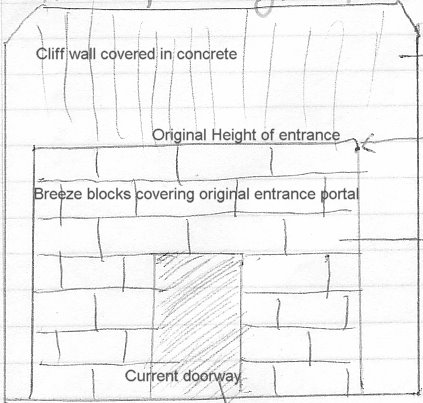
Developments
After discovering that the old railway tunnel entrance was still open, we entered it through a small door in the cliff of the pleasurama carpark entrance. Inside it was cool and dark. The roof was about 15 feet high, and was arched. The floor of the tunnel was covered in gravel and debris.

Remains of the old 'Tunnel Railway' sign - propped against the tunnel wall
About ten metres in from the entrance there was a crude barrier constructed from railings and other rubbish and debris, in an attempt to stop people from progressing any further.
 After climbing over the barrier, we progressed along this tunnel for about another two hundred metres, using a map to pinpoint the location at which the air raid tunnels intersected it.
Sure enough, there it was - an archway in the wall, about 7 feet high, with a long straight tunnel leading off beyond it, at right angles to the railway tunnel, hewn out of the chalk. Perhaps this was the one entrance that the council had overlooked, and forgotten to block off.
It was a lot warmer in these tunnels, and did not have a steady flow of air running through them as the railway tunnels had. It was a strange feeling actually being in these famous tunnels after all these years, 70 ft underground, which had seen so much history. The tunnel continued straight for about a hundred metres and then turned slightly (see map). Approximately every 10 feet there were alcoves dug out of the walls, which originally were meant for toilets, and to protect people from the draft.
After about a five minute walk, we came to a long spur tunnel leading off at right angles. At this junction there were two brightly painted oil drums, with the word 'BIN' stencilled on them, and also an old rusty bicycle.
Then in front of us we saw a broad flight of stairs leading up into the darkness. There was also a handrail running up the middle.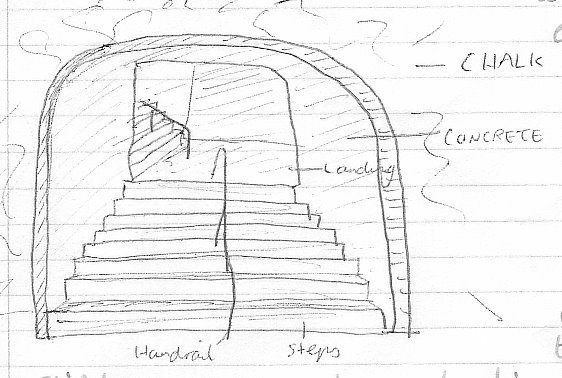 It was a weird feeling, seeing these stairs leading up to the surface, and it was not difficult to imagine the clamours of people flocking down these stairs during the raids, but now there was nothing but silence...
In the distance we could hear the sound of water dripping. One by one we climbed the stairs. After the first flight we came to a landing, and the tunnel turned, and we then climbed another two flights. There was the occasional rubble on the stairs. The tunnel turned yet again, and there were even more flights of stairs, showing just how deep we were underground.
 Steps leading up to the Arklow Square entrance
Eventually we climbed the stairs and reached a brick wall.
There was a large square hole knocked out of this wall, and we could see the original entrance beyond this, and we could also see how it had been blocked, with large concrete slabs covering it, and turf laid over the top, rendering it invisible from the surface. We were now below the Arklow Square entrance. It is actually possible to see this entrance from the surface during the height of summer, as the  rectangular shaped outline can be seen as dead grass when it dries out.
We then descended the stairs and continued on our journey. The air raid tunnels were supposed to be six feet wide, but at the moment they were about 4 feet wide. Our torches reflected off the chalk walls illuminating the passages before us.
After another hundred metres, the chalk walls turned to concrete, we had entered the reinforced section. After a while we came to another spur tunnel going off, also reinforced with concrete. There was also another shorter tunnel leading off which was almost blocked by a mound of dirt.
After climbing over this we came to a small brick room, with a small metal folding chair within it. There was a pale disc of light on the floor. Looking up, we saw a huge shaft, about half a metre in diameter, and extending straight upwards for 60 ft until it broke the surface. It was covered from the top with a circular manhole cover, with a cross allowing light to shine through.
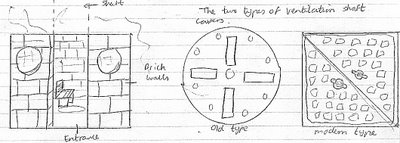
Continuing along this spur tunnel, we then came to a brick wall. It also had a large hole knocked in the wall, which we climbed through, and we then came to some more stairs leading up to the surface. This was at St. Luke's recreation ground. As the tunnels mainly stay level, at this point they were very near the surface, as they were at the lowest point of Ramsgate. This was probably why this section of the tunnels were heavily reinforced with concrete. There was only one flight of stairs leading to the surface this time.

Stairs leading up to the St.Lukes entrance
The same concrete slabs were there, with roots and even some daylight filtering through. Water was also dripping through and it was very damp.
 The sealed up St. Luke's air raid tunnel entrance shown from the surface
We then turned back and carried on down the tunnel for a short distance until we were met with a large blockage. It appeared to be a giant roof fall, but the collapse had blocked the entire tunnel!
To the left was a large tank, about 7ft by 5ft, and appeared to be a water reservoir. 
By this time we were below Boundary Road, and according to the plan were heading towards the Chatham House entrance, but we could get no further. We had explored about one third of the entire air raid tunnel system.
We were disappointed that we did not get all the way, but our torch batteries were low so we turned back.
The only way was to find another entrance to the network, but as they say, that was to be another adventure... 

Official 1939 plan of this tunnel section:

Old Scenes from the Railway tunnel shelter from WW2

A typical scene from the Railway tunnel section of Ramsgate's deep shelters, showing beds and a child's cot. The narrow gauge railway track is still clearly visible. This has long since been removed

The remains of one of these beds now, after being left for decades down the tunnel!

Safe Underground - A family party safe from air raiders in the old railway tunnel under Ramsgate.
-
In order to sleep in the tunnels overnight, a special ticket was required, in order to have a bunk, or 'private' cubicle.
It was signed by the 'senior sanitary inspector'. This particular ticket belonged to a Beatrice Pryor of Guildford Lawn.

A cheese and wine party being held in 1993! This gathering was held in the extremities of this section of the air raid tunnels, sitting at the base of the Chatham House School area where a collapse has blocked the passage totally
Labels: railway tunnel, wind, ww2
posted by Vince R at 11:13 pm
21 comments


